Home / CSCS test questions
CSCS test questions and answers
10 sample questions in the style of the CITB Health, Safety and Environment test, one from each of 10 topics. Try each one, then open the answer to see why every option is right or wrong.
These are our own practice questions, written from HSE guidance and the law. Nobody outside CITB has the questions used on the day, and anyone selling "real questions" is not telling the truth. What you can do is learn the rules the questions test.
1. Duties under the Health and Safety at Work etc. Act 1974
You have just started work for a groundworks firm. Your supervisor explains that health and safety law gives duties to workers as well as to employers.
Which two of these are your own legal duties as a worker? (Choose two.)
Choose two answers.
- AA. Buy the safety boots and hi-vis the job needs
- BB. Give first aid to anyone who is hurt on site
- CC. Take reasonable care of your own and other people's health and safety
- DD. Co-operate with your employer on health and safety
- EE. Write the risk assessment for each job you do
Show the answer and explanation
Answers: C, D
- A. Wrong: Wrong. Your employer must give you the safety equipment and protective clothing you need, free of charge. The law does not allow them to make you pay for it.
- B. Wrong: Wrong. Your employer must make first-aid arrangements, such as a first-aid kit and a person to take charge. Unless you are a trained first-aider, your job is to get help quickly.
- C. Right: Right. Section 7 of the Health and Safety at Work etc. Act 1974 says every worker must take reasonable care of themselves and of anyone affected by what they do, or fail to do, at work.
- D. Right: Right. Section 7 also says you must co-operate with your employer, so they can meet their own legal duties. That includes following site rules and safe ways of working.
- E. Wrong: Wrong. Deciding what could harm you and the precautions to take is your employer's duty. You follow the risk assessment and speak up if something in it looks wrong.
Explanation
Workers have two main duties under the Health and Safety at Work etc. Act: take reasonable care of yourself and others, and co-operate with your employer. Risk assessments, safety equipment and first-aid arrangements are your employer's job.
Study
More Duties under the Health and Safety at Work etc. Act 1974 questions
2. COSHH and hazardous substances
Your gang starts using a new floor adhesive. The supplier has sent a safety data sheet with it.
Which of these is true about the safety data sheet?
Choose one answer.
- AA. It is only needed if someone has already been harmed
- BB. It helps your employer work out how to use the product safely
- CC. It is the COSHH risk assessment, so nothing else is needed
- DD. It only matters to the person who ordered the product
Show the answer and explanation
Answer: B
- A. Wrong: Wrong. The information is needed before the product is used, so the right controls are in place from the start.
- B. Right: Right. A safety data sheet describes the product's hazards and how to handle, store and deal with it in an emergency. Your employer uses it to help make their own COSHH assessment.
- C. Wrong: Wrong. HSE says a safety data sheet is not a risk assessment. It gives information that helps your employer make one for the way the product is used on your site.
- D. Wrong: Wrong. The information is there so that the people using the product can be protected. Your employer should tell you what it means for the job you are doing.
Explanation
A safety data sheet tells you about a product's hazards and how to handle and store it. It is not a risk assessment, but it helps your employer make one.
Study
More COSHH and hazardous substances questions
3. Personal protective equipment
You start with a new firm. Your supervisor gives you safety glasses and gloves for the job, then says their cost will come out of your wages.
Is this allowed?
Choose one answer.
- AA. Yes, if you keep the PPE when you leave the firm
- BB. Only for gloves, because they wear out quickly
- CC. No, PPE needed for work must be free
- DD. Yes, as long as the cost is spread over a few weeks
Show the answer and explanation
Answer: C
- A. Wrong: Wrong. Who keeps it at the end does not change the rule. PPE provided for work must not be charged for.
- B. Wrong: Wrong. PPE that wears out still has to be replaced free of charge when it is needed for the work.
- C. Right: Right. The Health and Safety at Work Act says employers must not charge workers for things done to protect their health and safety at work. That includes PPE used only at work.
- D. Wrong: Wrong. Spreading the cost does not make it allowed. PPE needed for work must be provided free.
Explanation
Your employer must provide the PPE you need for your work and must not charge you for it. You must use it properly and report if it is lost or damaged.
Study
More Personal protective equipment questions
4. Lifting operations and lifting equipment
Your site uses chains, slings and shackles to lift loads with a crane. These are lifting accessories.
How often must they have a thorough examination, unless an examination scheme says otherwise?
Choose one answer.
- AA. Only when they look worn
- BB. At least every 3 years
- CC. At least every 6 months
- DD. At least every 12 months
Show the answer and explanation
Answer: C
- A. Wrong: Wrong. Faults are not always visible. Thorough examinations must be done at set intervals.
- B. Wrong: Wrong. That is far too long. Accessories must be examined at least every 6 months.
- C. Right: Right. Lifting accessories, and equipment used to lift people, must be thoroughly examined at least every 6 months. Other lifting equipment is at least every 12 months.
- D. Wrong: Wrong. 12 months is for other lifting equipment. Accessories such as chains and slings need examining more often.
Explanation
Lifting accessories and equipment for lifting people: thorough examination at least every 6 months. Other lifting equipment: at least every 12 months. Check accessories before each use, too.
Study
More Lifting operations and lifting equipment questions
5. Site induction and toolbox talks
You arrive on a new site for your first day. The gate team tells you to go straight up to the third floor, where the rest of your gang is already working.
What should happen before you start work?
Choose one answer.
- AA. You read the site rules on the noticeboard at your first break
- BB. You get an induction on this site's hazards and rules
- CC. Nothing, because you had an induction on your last site
- DD. You only need an induction if you are new to construction
Show the answer and explanation
Answer: B
- A. Wrong: Wrong. You need to know the site's hazards and emergency arrangements before you start, not partway through your first shift. A noticeboard does not replace an induction.
- B. Right: Right. HSE says every site worker must be given a suitable site induction. It is specific to the site and covers its main risks, the site rules, first aid and how to report accidents.
- C. Wrong: Wrong. Every site has its own hazards, rules and emergency arrangements. An induction from another site does not tell you about this one.
- D. Wrong: Wrong. Experience does not replace an induction. Every worker needs to know the hazards and rules of the site they are on, however long they have worked in construction.
Explanation
Every site worker must have a suitable induction for that site. It tells you the site's particular hazards, the site rules, the first-aid and emergency arrangements, and how to report accidents.
Study
More Site induction and toolbox talks questions
6. Asbestos awareness
You are drilling fixings into the ceiling of an office built in 1985. Above the ceiling tiles you find old grey boards that look like insulation.
What should you do?
Choose one answer.
- AA. Break off a piece and take it to the office to check
- BB. Carry on, as asbestos was banned long before 1985
- CC. Stop work and tell your supervisor before going on
- DD. Carry on, but open a window to let the dust out
Show the answer and explanation
Answer: C
- A. Wrong: Wrong. Breaking it releases fibres into the air. Only a trained person should take a sample.
- B. Wrong: Wrong. Asbestos was still used in buildings until 1999. Any building built or refurbished before 2000 may contain it.
- C. Right: Right. A building put up before 2000 may contain asbestos. Stop work and ask your employer to check the asbestos survey. Don't carry on until you know it is safe.
- D. Wrong: Wrong. Opening a window does not make asbestos safe. You can't see, smell or feel the fibres, and breathing them in can cause cancer decades later.
Explanation
If a building was built or refurbished before 2000 and you find something that might be asbestos, stop work and tell your supervisor. Don't carry on until the asbestos survey has been checked.
Study
More Asbestos awareness questions
7. Safety signs and signals
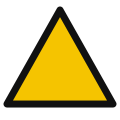
Safety signs on site use colour and shape to show what kind of message they give. You need to know them at a glance.
Which sign tells you that you must do something, such as wear a safety helmet?
Choose one answer.
- AA. Red ring with a diagonal bar

- BB. Yellow triangle with a black border
- CC. Blue circle

- DD. Green square

Show the answer and explanation
Answer: C
- A. Wrong: Wrong. A red ring with a bar is a prohibition sign. It tells you that you must not do something, such as smoke.
- B. Wrong: Wrong. A yellow triangle is a warning sign. It warns you of a danger, but it does not tell you what to do.
- C. Right: Right. A blue circle is a mandatory sign. It tells you that you must do something, such as wear a safety helmet or eye protection.
- D. Wrong: Wrong. A green square or rectangle is a safe condition sign. It shows first aid, emergency exits or escape routes.
Explanation
Blue circles say what you must do. Red rings with a bar say what you must not do. Yellow triangles warn of danger. Green squares show first aid and the way out.
Study
More Safety signs and signals questions
8. Plant and site transport
A banksman is guiding a lorry as it reverses into the site. Part way back, the driver can no longer see the banksman.
What should the driver do?
Choose one answer.
- AA. Use the mirrors and finish the reverse alone
- BB. Stop immediately
- CC. Keep reversing slowly until the banksman appears again
- DD. Sound the horn and keep going
Show the answer and explanation
Answer: B
- A. Wrong: Wrong. The lorry has a banksman because the driver can't see everything. Stop and wait.
- B. Right: Right. HSE says if drivers lose sight of the banksman or signaller they should stop immediately.
- C. Wrong: Wrong. The banksman may be in the lorry's path. The driver must stop until they can see the banksman again.
- D. Wrong: Wrong. A horn doesn't tell the driver where the banksman or anyone else is.
Explanation
If a driver loses sight of the banksman, they must stop straight away. Banksmen stand where they can be seen and are out of the vehicle's path.
Study
More Plant and site transport questions
9. Risk assessments and method statements
During a toolbox talk, your supervisor points to an extension lead trailing across a walkway. They say the lead is a hazard.
Which of these describes the risk?
Choose one answer.
- AA. The chance someone trips, and how badly they're hurt
- BB. The trailing extension lead lying across the walkway
- CC. The name of the person who set up the extension lead
- DD. The cost of replacing the lead if it gets damaged
Show the answer and explanation
Answer: A
- A. Right: Right. A risk is the chance that a hazard will harm someone, together with how serious that harm could be. HSE asks you to think about both when assessing risks.
- B. Wrong: Wrong. The lead is the hazard: something that could cause harm. The risk is how likely that harm is, and how bad it could be.
- C. Wrong: Wrong. Knowing who set it up may help put it right, but it is not the risk. The risk is about the chance and seriousness of harm.
- D. Wrong: Wrong. Risk assessment is about harm to people, not the cost of equipment. A damaged lead is a hazard in itself, so it should be taken out of use.
Explanation
A hazard is anything that could cause harm. The risk is how likely it is that someone is harmed, and how badly.
Study
More Risk assessments and method statements questions
10. Noise and vibration
You are working near a road saw. To talk to your workmate, who is about 2 metres away, you have to shout.
What does this tell you?
Choose one answer.
- AA. Noise is only harmful if your ears hurt afterwards
- BB. The noise could be damaging your hearing
- CC. Your workmate needs to have their hearing tested
- DD. The noise is only a problem if it lasts a full shift
Show the answer and explanation
Answer: B
- A. Wrong: Wrong. Noise damage is usually painless. Ringing or dull hearing after work are warning signs, and the damage is permanent.
- B. Right: Right. HSE says that if you have to shout to talk to someone 2 metres away, the noise is probably 85 dB or more. At that level hearing protection must be provided and worn.
- C. Wrong: Wrong. The problem is the noise level, not your workmate. Anyone working in that noise for long is at risk.
- D. Wrong: Wrong. Hearing damage builds up over time, but at this level even a couple of hours a day can harm your hearing.
Explanation
If you have to shout to be heard 2 metres away, the noise is probably loud enough to damage your hearing. Wear your hearing protection and ask about quieter ways of working.
Study
More Noise and vibration questions