There were very strong winds overnight. The scaffold you are working on was last inspected three days ago.
What should happen before anyone uses it?
Choose one answer.
AA. The first person up should give it a shake to check it
BB. Use it, but only on the lower lifts
CC. A competent person must inspect it again
DD. Nothing, as the next inspection isn't due for four days
Show the answer and explanation
Answer: C
A. Wrong: Wrong. The inspection must be done properly by a competent person, not by a quick check from a user.
B. Wrong: Wrong. Wind damage could affect any part of the scaffold, including the ties and base.
C. Right: Right. A scaffold must be inspected before first use, at least every 7 days, and after anything that could affect its safety, such as high winds.
D. Wrong: Wrong. The 7-day inspection is the longest gap allowed. Events such as high winds mean it needs checking again first.
Explanation
Scaffolds are inspected by a competent person before first use, at least every 7 days, and after anything that could affect them, such as strong winds.
You are working on a scaffold. A guard-rail is in the way of the bricks you need to lay.
What should you do?
Choose one answer.
AA. Take it off, then put it back when you have finished
BB. Take it off and tie a rope across the gap instead
CC. Lean over it to lay the bricks
DD. Ask your supervisor to get a scaffolder to alter it
Show the answer and explanation
Answer: D
A. Wrong: Wrong. You might forget, or someone else could fall while it is off. Scaffolds must only be altered by competent people.
B. Wrong: Wrong. A rope is not strong or rigid enough to stop someone falling. Guard-rails must be at least 950 mm high.
C. Wrong: Wrong. Leaning over a guard-rail puts you at risk of falling. Get the scaffold altered so you can work safely.
D. Right: Right. Only competent scaffolders should alter a scaffold. Removing a guard-rail yourself could leave you, or someone else, at risk of falling.
Explanation
Never remove or alter any part of a scaffold yourself. Ask for a competent scaffolder to make the change.
A scaffold platform has a main guard-rail along its open edge.
What is the lowest height that guard-rail should be above the platform?
Choose one answer.
AA. 950 mm
BB. 470 mm
CC. 600 mm
DD. 1,500 mm
Show the answer and explanation
Answer: A
A. Right: Right. The top guard-rail must be at least 950 mm above the edge people could fall from. Any gap below it must be no more than 470 mm.
B. Wrong: Wrong. 470 mm is the largest gap allowed between guard-rails, not the height of the top rail.
C. Wrong: Wrong. A rail this low would be below most people's waist, so they could fall over it.
D. Wrong: Wrong. A top rail doesn't have to be this high. The minimum is 950 mm.
Explanation
The main guard-rail must be at least 950 mm high, with an intermediate rail or barrier so that no gap is more than 470 mm, and a toe board at the bottom.
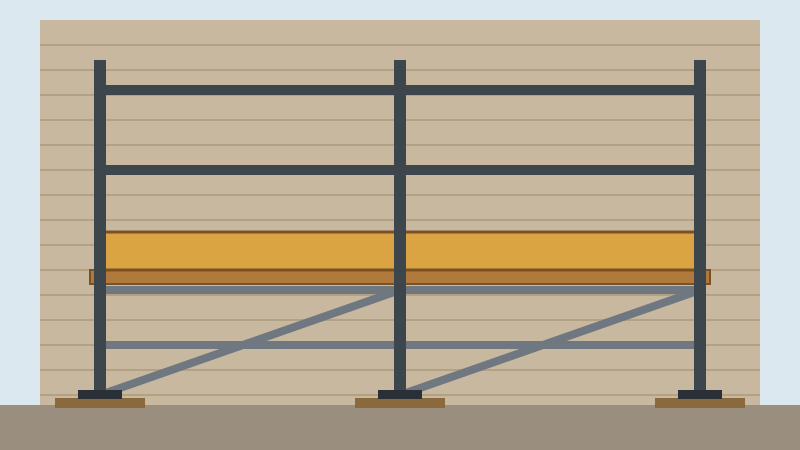
This scaffold has a working platform with edge protection.
Which part stops tools and materials falling off the edge of the platform?
1234
Choose one of the numbered areas on the picture.
Show the answer and explanation
Answer: area 3, the toe board
The top guard-rail: Wrong. The top guard-rail stops people falling over the edge. It is too high to stop things sliding off the platform.
The intermediate guard-rail: Wrong. The intermediate rail closes the gap below the top rail so people can't fall through. It does not stop small objects at platform level.
The toe board: Right. The toe board runs along the edge of the platform. It stops tools, bricks and other materials being kicked or knocked off onto people below.
A base plate: Wrong. Base plates spread the load of the uprights onto the ground. They don't protect the platform edge.
Explanation
Guard-rails stop people falling. The toe board, at the platform edge, stops materials and tools falling onto people below.
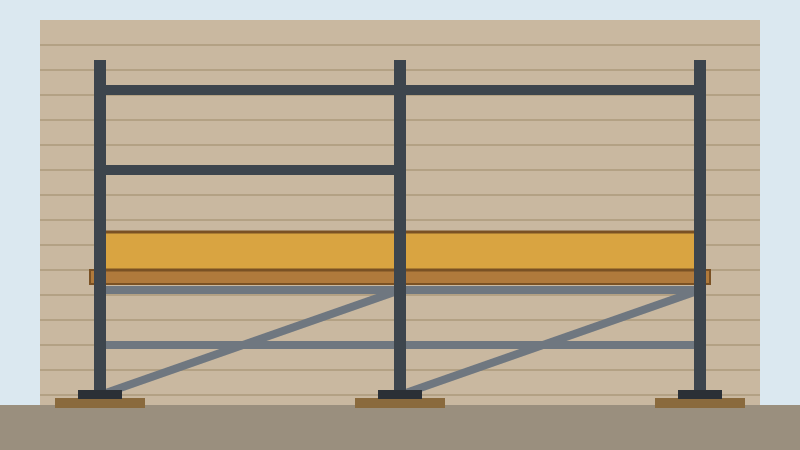
This scaffold has one fault that means it should not be used until a scaffolder puts it right.
Click on the fault.
Find the right place on the picture. In the practice test you click or tap it.
Show the answer and explanation
Answer: the gap below the top rail in the right-hand bay
The gap below the top rail in the right-hand bay: Right. The intermediate guard-rail is missing in the right-hand bay. The gap is far bigger than 470 mm, so someone could fall through it.
The guard-rails in the left-hand bay: Wrong. The left-hand bay has a top rail and an intermediate rail, so it is protected.
The toe boards: Wrong. The toe board runs the full length of the platform in both bays.
The base plates: Wrong. All three uprights stand on base plates on timber boards.
Explanation
Every open edge of a working platform needs a top guard-rail, an intermediate rail or barrier so no gap is over 470 mm, and a toe board. If any are missing, don't use the scaffold and report it.